
GFS Neohellenic
Designed By
Greek Font Society
4 Styles Sans Serif
Letters for
every day.
GFS Neohellenic · Regular
Compare the family in headings, short labels and paragraph text.
4 styles available. Compare the specimens below, or enter your own text.
Download GFS Neohellenic ↓TTF · SIL Open Font License 1.1
Set Your Own Text
Change the style and size to compare the letterforms.
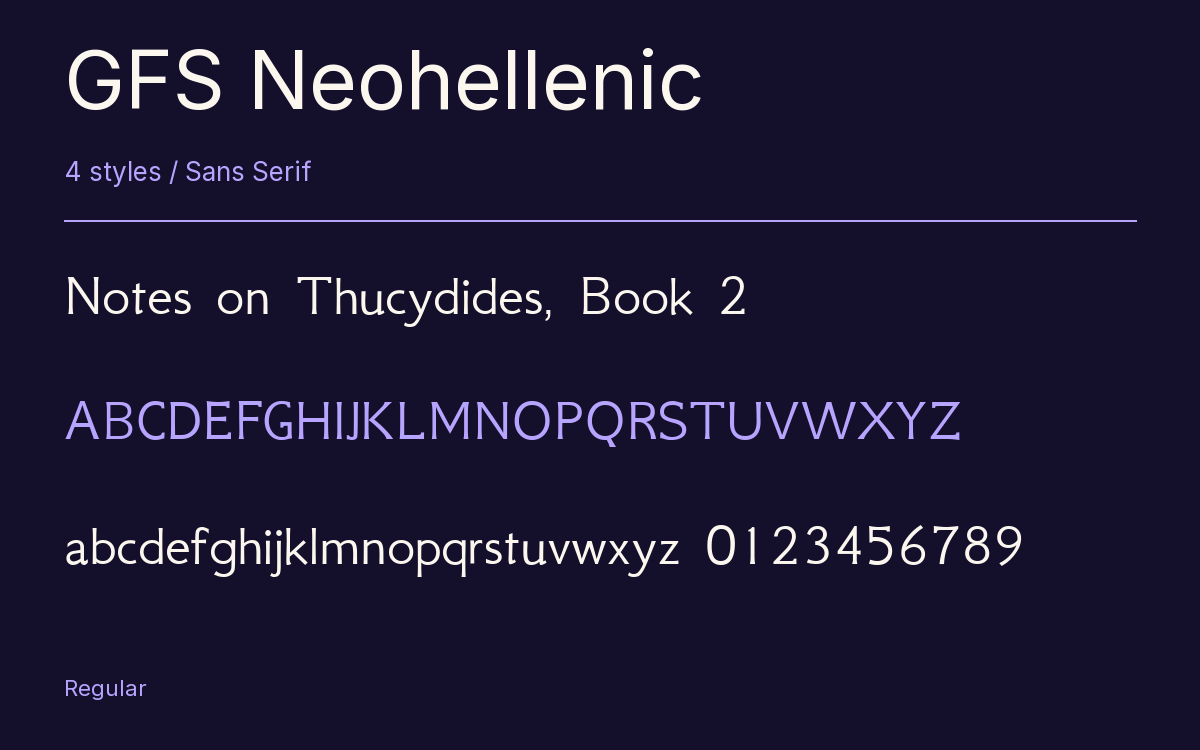
Notes on Thucydides, Book 2
A Clear Hierarchy
GFS Neohellenic · Regular
Headings, labels and running text.
Departures09:00 →
Before You Travel
The morning service leaves at nine. Tickets are available at the station, and the platform is listed on the departure board. Keep your ticket until the end of the journey.
4 Styles,
One Family
Every available style is shown below in its own font file.
Regular400
Notes on Thucydides, Book 2
Italic400
Notes on Thucydides, Book 2
Bold700
Notes on Thucydides, Book 2
Bold Italic700
Notes on Thucydides, Book 2
The letters go back to Venice in 1492, to an edition of Macrobius printed in the shop attributed to Giovanni Rosso, also known as Joannes Rubeus. His Greek was round and close to monoline, with very little difference between thick and thin. A British scholar brought it back in the 20th century.
That was Victor Scholderer of the British Museum Library. By the late 19th century the people who cared about Greek type in Britain wanted it to match an idealized, never quite defined “greekness” of the past, and Scholderer, following his predecessor Richard Proctor, held the same view. In 1927 the Society for the Promotion of Greek Studies asked him to advise on a new face, and he picked the Rosso type for revival. Lanston Monotype cut it as New Hellenic. No Greek type had succeeded in Britain like it since Porson Greek, more than a century earlier, and from the 1930s it was taken up in Greece as well, with a redrawn Ξ and Ω.
The Greek Font Society digitized it in 1993 and 1994 with money from the Athens Archaeological Society, adding a set of epigraphical symbols for inscriptions. Italic, Bold and Bold Italic followed in 2000, together with a Latin to go beside the Greek. Takis Katsoulidis and George D. Matthiopoulos did the work.
The 4 styles carry small caps, old style and lining figures, and the extended Greek needed for polytonic text. Its lowercase is low against the capitals, so give it a slightly bigger size than you would a modern sans.
A classics journal or a parallel-text edition is where we would put it.
Characters & Figures
1,104 glyphs reported in the reference style. This selection shows 400 recorded characters.
ABCDEFGHIJKLMNOPQRSTUVWXYZ
abcdefghijklmnopqrstuvwxyz
0123456789 & @ ? !
View The Recorded Character Selection
The Font Files
Download
GFS Neohellenic
4 TTF styles with the accompanying CSS, README and license information.
Download ZIP · 472 KB ↓- Version
- 1.0
- License
- SIL Open Font License 1.1
Install On Your Computer
Extract the ZIP first. On Windows, select the font files and choose Install from the context menu. On macOS, open the files in Font Book and choose Install.
Use On A Website
Keep the font files and the included stylesheet together. Update the stylesheet path to match your project.
<link rel="stylesheet"
  href="/fonts/gfs-neohellenic-2/gfs-neohellenic-2.css">

body {
  font-family: 'GFS Neohellenic', sans-serif;
}
Keep the copyright and license notices with redistributed files.
Heading & Body
Compare a larger heading with the same family at reading size.
GFS Neohellenic Heading · GFS Neohellenic Body
Before You Travel
The morning service leaves at nine. Tickets are available at the station, and the platform is listed on the departure board. Keep your ticket until the end of the journey.