
Noto Serif Armenian
Designed By
9 Styles Serif
The pleasure
of a well-set
page.
Noto Serif Armenian · Regular
Compare this serif family in headings and a continuous reading sample.
9 styles available. Compare the specimens below, or enter your own text.
Download Noto Serif Armenian ↓TTF · SIL Open Font License 1.1
Set Your Own Text
Change the style and size to compare the letterforms.
Letters home from Yerevan
A Page In Noto Serif Armenian
Noto Serif Armenian · Regular
Headings, labels and running text.
Notes From The Reading Room
The reading room opens onto a quiet courtyard. Along the shelves, small handwritten labels mark the collections. A visitor leaves a book open beside the window, keeping a place for the next reader.
A heading marks the next chapter. The margins leave room for a note while the text continues across the page.
9 Styles,
One Family
Every available style is shown below in its own font file.
Thin100
Letters home from Yerevan
Extra Light200
Letters home from Yerevan
Light300
Letters home from Yerevan
Regular400
Letters home from Yerevan
Medium500
Letters home from Yerevan
Semi Bold600
Letters home from Yerevan
Bold700
Letters home from Yerevan
Extra Bold800
Letters home from Yerevan
Black900
Letters home from Yerevan
Mesrop Mashtots created the Armenian alphabet around 405 CE, and it is still the alphabet the Armenian language is written in, by something like 12 million people. It is bicameral, with capitals and small letters like Latin, and it runs left to right, which makes a serif design for it a fairly natural thing to build next to a Latin serif.
Noto Serif Armenian is the modulated, serif branch of Google’s Noto coverage for the script, drawn by the Monotype design team. It is meant for running text. 9 weights ship in the download, Thin at 100 through Black at 900, and the Latin that comes along is a matching serif, so a page in Armenian with English names or dates in it does not need a second family.
A detail from the history, for anyone setting real text: Armenia itself uses a reformed spelling that was introduced in the Soviet period, while most of the diaspora kept the original Mesropian orthography.
In the 18th and 19th centuries the script was also widespread in the Ottoman Empire. For a reissue or a community newsletter we would start at Regular for the body and keep the Black for a masthead.
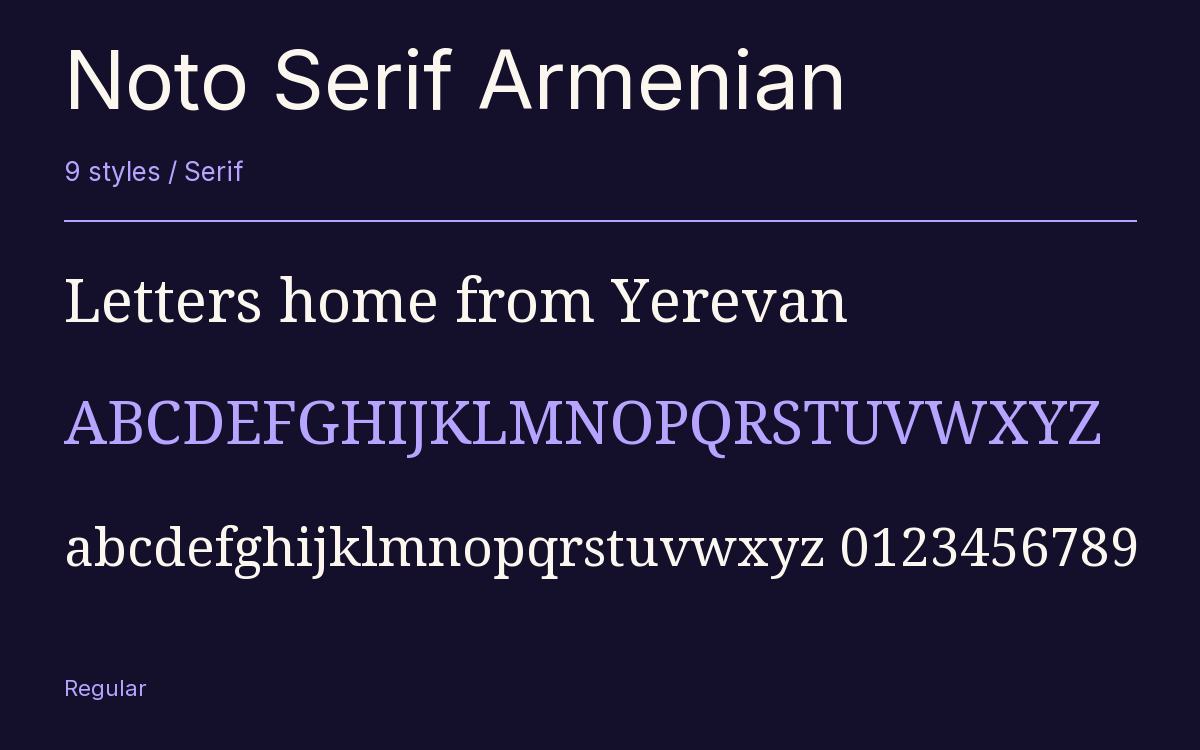
Characters & Figures
430 glyphs reported in the reference style. This selection shows 400 recorded characters.
ABCDEFGHIJKLMNOPQRSTUVWXYZ
abcdefghijklmnopqrstuvwxyz
0123456789 & @ ? !
View The Recorded Character Selection
The Font Files
Download
Noto Serif Armenian
9 TTF styles with the accompanying CSS, README and license information.
Download ZIP · 275 KB ↓- Version
- 2.008
- License
- SIL Open Font License 1.1
Install On Your Computer
Extract the ZIP first. On Windows, select the font files and choose Install from the context menu. On macOS, open the files in Font Book and choose Install.
Use On A Website
Keep the font files and the included stylesheet together. Update the stylesheet path to match your project.
<link rel="stylesheet"
  href="/fonts/noto-serif-armenian-2/noto-serif-armenian-2.css">

body {
  font-family: 'Noto Serif Armenian', sans-serif;
}
Keep the copyright and license notices with redistributed files.
Heading & Body
The family provides the heading; Inter carries the supporting text.
Noto Serif Armenian Heading · Inter Body
Notes From The Reading Room
The reading room opens onto a quiet courtyard. Along the shelves, small handwritten labels mark the collections. A visitor leaves a book open beside the window, keeping a place for the next reader.
Other Serif Families
Browse All Serif Fonts → Serif1 StyleFontshare
- PrataSerif1 StyleGoogle Fonts
- AmiriSerif4 StylesGoogle Fonts
- Andada ProSerif10 StylesGoogle Fonts
- PridiSerif6 StylesGoogle Fonts
 Serif1 StyleFontshare