
Noto Serif Ethiopic
Designed By
9 Styles Serif
The pleasure
of a well-set
page.
Noto Serif Ethiopic · Regular
Compare this serif family in headings and a continuous reading sample.
9 styles available. Compare the specimens below, or enter your own text.
Download Noto Serif Ethiopic ↓TTF · SIL Open Font License 1.1
Set Your Own Text
Change the style and size to compare the letterforms.
Coffee ceremony after the market
A Page In Noto Serif Ethiopic
Noto Serif Ethiopic · Regular
Headings, labels and running text.
Notes From The Reading Room
The reading room opens onto a quiet courtyard. Along the shelves, small handwritten labels mark the collections. A visitor leaves a book open beside the window, keeping a place for the next reader.
A heading marks the next chapter. The margins leave room for a note while the text continues across the page.
9 Styles,
One Family
Every available style is shown below in its own font file.
Thin100
Coffee ceremony after the market
Extra Light200
Coffee ceremony after the market
Light300
Coffee ceremony after the market
Regular400
Coffee ceremony after the market
Medium500
Coffee ceremony after the market
Semi Bold600
Coffee ceremony after the market
Bold700
Coffee ceremony after the market
Extra Bold800
Coffee ceremony after the market
Black900
Coffee ceremony after the market
About 18 million people write in Ethiopic, an African abugida read from left to right, where a character stands for a consonant together with its vowel. A font for it ends up as a big set of closely related forms that have to stay distinct at reading size.
Noto Serif Ethiopic is the modulated, serif design for the script in Google’s Noto collection, drawn by Monotype’s design team. Amharic and Tigrinya are the big languages it serves, along with Tigré and some Cushitic and Nilotic languages. Ge’ez, the language the script was first used for in Ethiopia and Eritrea between the 1st and 12th centuries, survives now as a liturgical language, so a church text set in it is as much a use as a newspaper.
The weights
9 of them, Thin at 100 to Black at 900. With so many closely related forms, our choice for running text is Regular or Medium; the Thin is for a large title, where the fine strokes have the size to hold up. Shaping support in the software is needed for the script to display correctly.
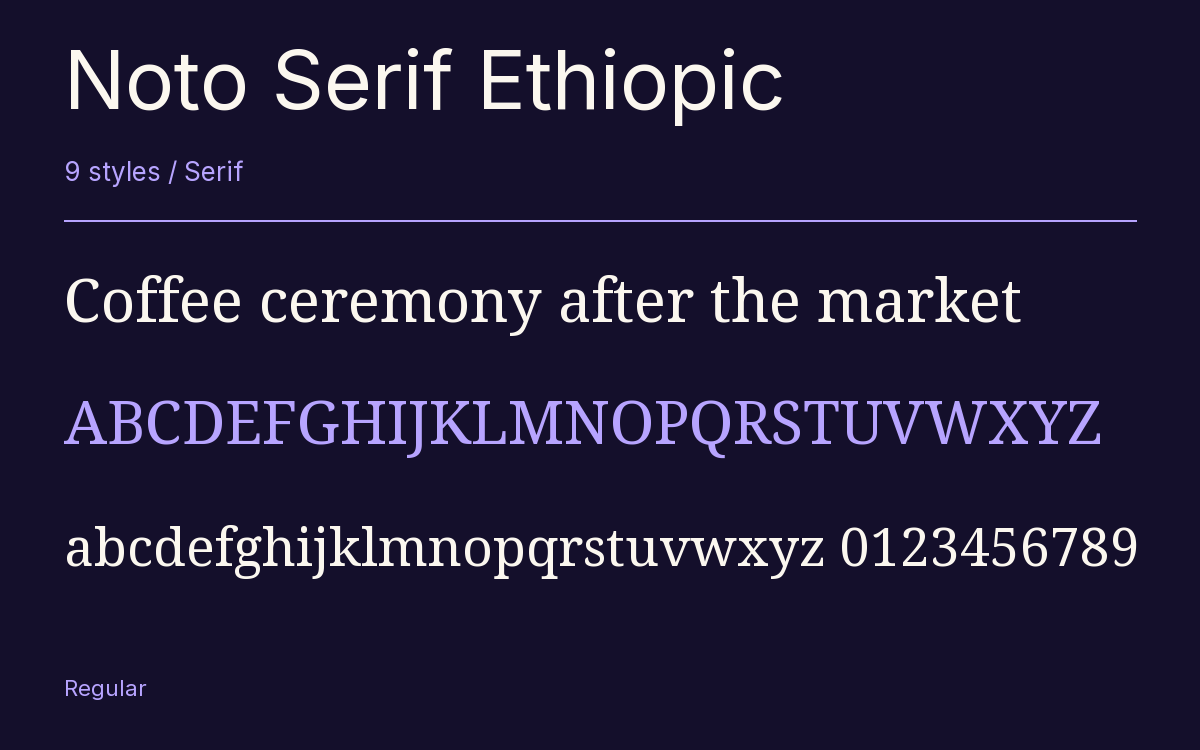
Characters & Figures
860 glyphs reported in the reference style. This selection shows 400 recorded characters.
ABCDEFGHIJKLMNOPQRSTUVWXYZ
abcdefghijklmnopqrstuvwxyz
0123456789 & @ ? !
View The Recorded Character Selection
The Font Files
Download
Noto Serif Ethiopic
9 TTF styles with the accompanying CSS, README and license information.
Download ZIP · 966 KB ↓- Version
- 2.102
- License
- SIL Open Font License 1.1
Install On Your Computer
Extract the ZIP first. On Windows, select the font files and choose Install from the context menu. On macOS, open the files in Font Book and choose Install.
Use On A Website
Keep the font files and the included stylesheet together. Update the stylesheet path to match your project.
<link rel="stylesheet"
  href="/fonts/noto-serif-ethiopic-2/noto-serif-ethiopic-2.css">

body {
  font-family: 'Noto Serif Ethiopic', sans-serif;
}
Keep the copyright and license notices with redistributed files.
Heading & Body
The family provides the heading; Inter carries the supporting text.
Noto Serif Ethiopic Heading · Inter Body
Notes From The Reading Room
The reading room opens onto a quiet courtyard. Along the shelves, small handwritten labels mark the collections. A visitor leaves a book open beside the window, keeping a place for the next reader.